Шумоизоляция помещений: common mistakes that cost you money
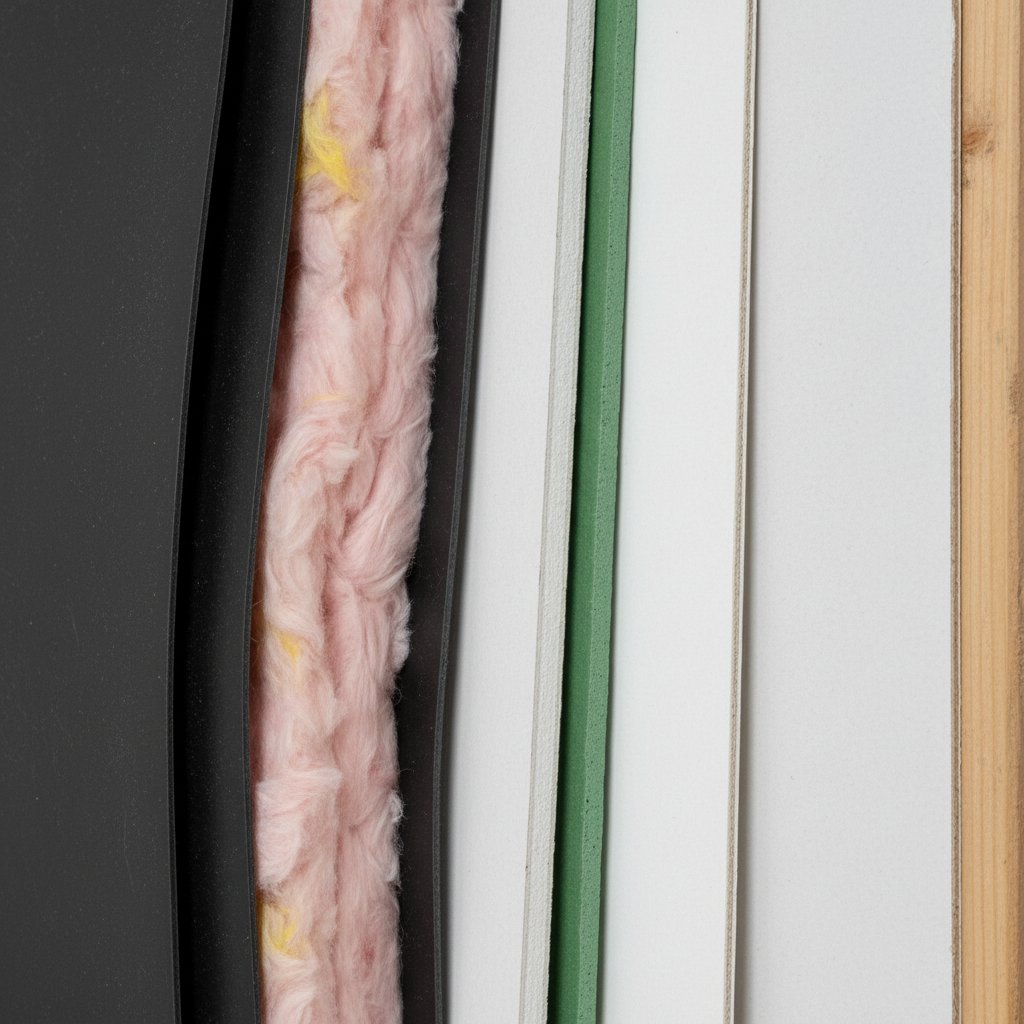
Soundproofing Mistakes That Are Draining Your Wallet
You've had enough of the neighbor's late-night guitar sessions bleeding through your walls. Or maybe your home studio sounds more like an echo chamber than Abbey Road. So you dive into soundproofing—and suddenly you're $3,000 deep with results that barely move the needle.
Here's the thing: most people approach acoustic treatment in one of two ways. They either go the DIY route with YouTube tutorials and egg cartons, or they throw money at expensive materials without understanding the fundamentals. Both camps make costly mistakes, just in different ways.
Let's break down these two approaches and see where people typically go wrong.
The Budget DIY Approach: When Cheap Gets Expensive
What People Usually Do
The budget-conscious crowd starts with foam panels from Amazon, maybe some moving blankets, and that legendary egg carton myth that refuses to die. They'll spend $200-500 on materials and dedicate a weekend to installation.
The Hidden Costs
- Treating symptoms, not causes: Those 1-inch foam panels absorb high frequencies beautifully. Low-frequency rumble? It laughs at them and walks right through. You've spent $300 but the bass from next door still rattles your windows.
- The redo penalty: After three months of minimal improvement, most people rip everything down and start over. That's $500 in materials plus another $800-1,200 in proper solutions. You've just paid 2.4x what you would have spent doing it right initially.
- Cosmetic damage: Adhesive-mounted panels leave residue. Command strips fail. Now you're repainting or patching drywall—add another $200-400 if you hire someone, or an entire weekend if you DIY.
- The opportunity cost: Six months of continued noise disturbance while you figure things out. If you're losing sleep or productivity, that's harder to quantify but very real.
Where This Approach Works
Fair is fair—the budget method isn't always wrong. If you're dealing with echo reduction in a podcast room or taming reflections in a small space, basic acoustic foam does the job. Studios on a shoestring have produced great content with $400 worth of strategically placed absorption.
The Premium Overkill Approach: Diminishing Returns in Action
What People Usually Do
On the flip side, you've got folks who buy mass-loaded vinyl, resilient channels, double-stud walls, and acoustic caulk by the case. Budget: $5,000-15,000 for a single room.
Where Money Gets Wasted
- Ignoring flanking paths: You build a fortress wall with an STC rating of 65, but forget about the HVAC ductwork. Sound travels through those ducts like a highway. That $8,000 wall delivers maybe 40% of its potential performance.
- Over-engineering for the wrong problem: Someone dealing with airborne voice transmission installs floor underlayment designed for impact noise. That's $2,000 spent on materials that don't address their actual issue.
- Skipping the assessment: Professional acousticians charge $500-800 for a proper room analysis. Many skip this "expense" then spend $12,000 on solutions that target the wrong frequencies or locations.
- Installation errors: Mass-loaded vinyl works great—if installed correctly. Leave gaps or use the wrong fasteners, and you've created acoustic leaks. The material cost $1,500; the performance is equivalent to $400 worth of properly installed alternatives.
Where This Approach Works
High-end solutions absolutely deliver when properly specified. Recording studios, home theaters, and spaces requiring serious isolation need these materials. A correctly built room can achieve STC ratings of 70+, blocking 99.9% of sound transmission.
Side-by-Side Reality Check
| Factor | Budget DIY | Premium Approach |
|---|---|---|
| Typical Cost | $200-500 initial | $5,000-15,000 |
| Common Mistake | Confusing absorption with isolation | Ignoring flanking paths |
| Redo Rate | ~60% need to start over | ~25% need corrections |
| Time Investment | 1-2 weekends | 1-3 weeks with contractors |
| Performance Gap | Works for 30% of issues | Works for 85% when done right |
| Biggest Risk | Wasting money twice | Over-spending on wrong solutions |
The Smart Middle Ground
Most people don't need studio-grade isolation or bargain-bin foam. They need a diagnosis-first approach.
Spend $100-200 on a decibel meter and frequency analyzer app. Identify whether you're fighting airborne sound, impact noise, or resonance issues. A structural engineer friend once told me: "Measure twice, spend once." He was talking about construction, but it applies perfectly here.
For $1,500-3,000, you can address 80% of typical residential sound issues with targeted solutions: proper door seals ($150), strategic mass addition to weak walls ($800), and decoupling where it actually matters ($600). The remaining $450 covers quality acoustic treatment for the frequencies you actually need to absorb.
The expensive mistake isn't choosing budget or premium. It's choosing solutions before understanding your problem. That's where the real money disappears—along with your peace and quiet.